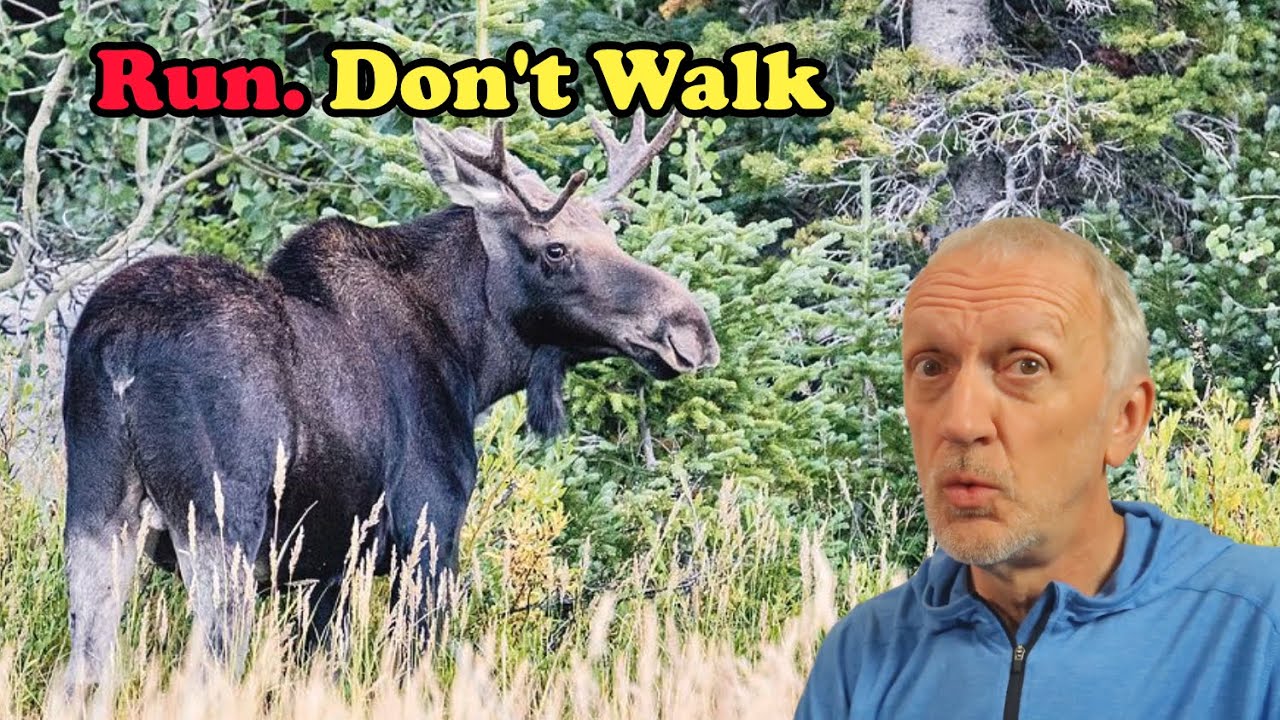
I Had an Unexpected Moose Encounter on the Trail
What’s more dangerous – a black bear or a moose?
In Colorado, moose injure more people every year than black bears do.
Moose are large animals. They can weigh up to 1800 pounds and their antlers can spread up to 6 feet wide. It is the tallest and second-largest land animal in North America. It is a majestic beast that you don’t want to mess with.
Probably not a surprise, but direct attacks from moose happen when they feel threatened or provoked. They may appear to be slow and gentle giants, but a moose cow can be aggressively protective of their calves. And bull moose can be territorial especially during rutting season in the fall.
Moose attacks can be triggered if they are harassed by people, dogs, or traffic. Obviously you will want to keep a good distance. I’ve seen YouTube videos of people putting themselves within a few feet of these animals. That might be a thrill but, if your lucky, you’ll only have a big hospital bill and months of recovery. It’s just not what smart people do.
Keep at least 100 feet between you and the moose. Keep dogs on leashes and controlled and far away. Dogs tend to harass moose, which can lead to a dead dog with one stomp of it’s hoof. So if you want your best friend around for a while, you’ll get you and your dog far away from the moose.
If you are driving and see a moose, slow down or completely stop, don’t honk or pretend you can scare it off with your car. There are about 450 fatalities every year with moose-vehicle collisions. Just give the moose as much distance as possible and give it time to move.
In winter when they are hungry or stressed, they may become irritated. So again, just keep a good distance.
Warning signs of a charge include laid-back ears, raised hair on it’s neck and back, lip licking, a lowered head, swaying, or showing the whites of its eyes. If it charges, take cover behind a large trees, rocks, cars; just get something large between you and the animal. Also, if a moose knocks you down, it will probably start stomping on you with those massive hooves, one stomp in the middle of your chest or head may be the end of you. These animals are not hunting you down – they just want to be left alone.
I’ve had several encounters. Here's one especially memorable:
It was in October and I was on an overnight trip to summit a couple of smaller peaks in Colorado. The trail follows an alpine drainage that had several marshy areas along the way. This is prime moose territory. I was done climbing and on my way down the mountain.
Like on most of my solo hikes, I was making plenty of noise, so I wouldn’t startle any animals.
I came around a bend that opened into a small meadow. The trail and a small creek followed the edge of the meadow.
About half way through and off to my left I heard several quick guttural sounds.
What was that? I slowed down so I could listen closer. It repeated several times but I couldn’t see yet what was making the sound. It was something that wanted to be noticed, for sure. And probably some animal that didn’t want me to be here.
It took a minute, but there it was, a juvenile bull moose, maybe a 2-3 years old. He had one antler missing – it was a bit too early in the season for them to shed their antlers, so, I know this one got tangled up with something.
He was about 100 feet away, walking slowly in the same direction as me - grunting with every step it took. The fur on the back of it’s neck was already standing up, ears were drawn back.
It’s important to know that these animals are near sighted – everything at a distance is a blur for them. So, they will appear to stare or study you. Which can get a little unnerving. And that’s what it was doing.
I quickly surveyed the area for a plan. If the bull turned my direction, what is my escape route? What can I get behind if it gets too close?
But, in that moment, instead of instantly running, I just watched for a minute to see what decisions it was making, to see if it was going to be aggressive and charge me or if it was just making noise to warn me that I was in his territory.
After probably a minute, maybe less, and a few more grunts, it moved out of the meadow and into the trees on the other side. But it was still going the direction I was going.
I waited another few more minutes until I couldn’t see him any more, thinking if he’s out of sight, it’s safe now. Then I slowly continued down the trail about another 100 yards, listening and watching closely, until I was about to cross the creek.
Suddenly, I heard that same grunt, behind me this time and very close. I heard rocks being kicked and shuffled.
As I turned to see behind me – there it was – maybe 6 feet away, it’s back was almost as tall as I was. We were way too close - there was no way I was escaping whatever this moose had in mind for me.
Luckily, it trotted by me. Turning it’s head and glancing back. I could see the whites of it’s eyes. It’s hooves were planting heavy on the ground.
I may have made up a couple words I don’t think I’ve spoken since then, turned toward the creek, quickly hopped across it over some rocks, making sure I knew exactly where that beast was at all times. It didn’t follow me, it just kept going, following the creek on the other side.
As I climbed the hill on one side of the creek, he continued down the hill on the other side. I kept moving, watching him along the way until I couldn’t see him any more. I just kept going as quick as I could, watching and listening carefully, until I felt I had enough distance between me and the bull before I slowed down. That was crazy!
What I Learned
I really didn’t know much about moose behavior before I went out on this hike. I learned later that October is their rutting season and that bulls can become territorial and aggressive.
One expert I talked with said that this was possibly a false charge, which is the bull’s way of communicating that I should not be there. He said a second charge would likely have been more intentionally designed to remove the threat... me.
Until a person has this kind of encounter, it’s impossible to comprehend the size of these creatures, and the kind of speed, power, and stealth they have. I don’t know how this bull got behind me without me hearing it. There was lots of trees and brush – it was fall with crunchy leaves on the ground. I learned that large and powerful doesn’t mean noisy or clumsy. They can be very stealthy.
I also learned that when a bull moose decides you’re a threat, you can only hope the beast is less determined to remove you than you are to remove yourself from the situation.
Conclusion
Maybe this animal’s instinct somehow knew I was just an innocent hiker passing by. I don’t know. But I do know that I feel grateful and maybe lucky to be able to tell you what happened here. I hope this helps you with your next moose encounter.
I’ve had other moose encounters not nearly as close and dangerous as this one. I walked up on a mature cow along the Colorado Trail one early morning. I noticed fresh tracks on the trail but didn’t realize how fresh they were. As soon as she saw me, she ran off trail – maybe 20 feet in front of me. It was about as big as the bull moose I encountered. So, don’t think cows are not potentially dangerous. I encountered a cow and calf on Isle Royal when I was a teenager. They just ran off. Whew!
Near Maroon Bells in Colorado I also walked up behind a bull moose, maybe 10 feet away. It was too busy munching on some willow brush to care much about me. I got out of there quickly and watched him from a distance for quite a while.
Another encounter was in the Lost Creek Wilderness Area in Colorado. It was also a young bull, but this time it was the middle of summer. I had spooked it and it was running away by the time I saw it through some thicker forested area.
I’ve also seen much larger bull moose at much greater distances in the Lost Creek area. So, if you are hiking, especially through the gulches in the Lost Creek Area, just know there is a good population of moose there.
Moose are truly majestic and incredible animals with unique behaviors that demand our respect and admiration. If you ever see one, take the appropriate safety precautions and then count your blessings. Not many people get to experience what we do in nature.
Now, go live like you want it.
Here are a few research links:
https://biologyinsights.com/how-many-people-die-from-moose-each-year/
https://northamericannature.com/moose-behavior/
https://www.nwf.org/Educational-Resources/Wildlife-Guide/Mammals/Moose
https://www.nps.gov/articles/000/moose-collisions.htm