Six Moon Designs Minimalist V2 Ultralight Backpack
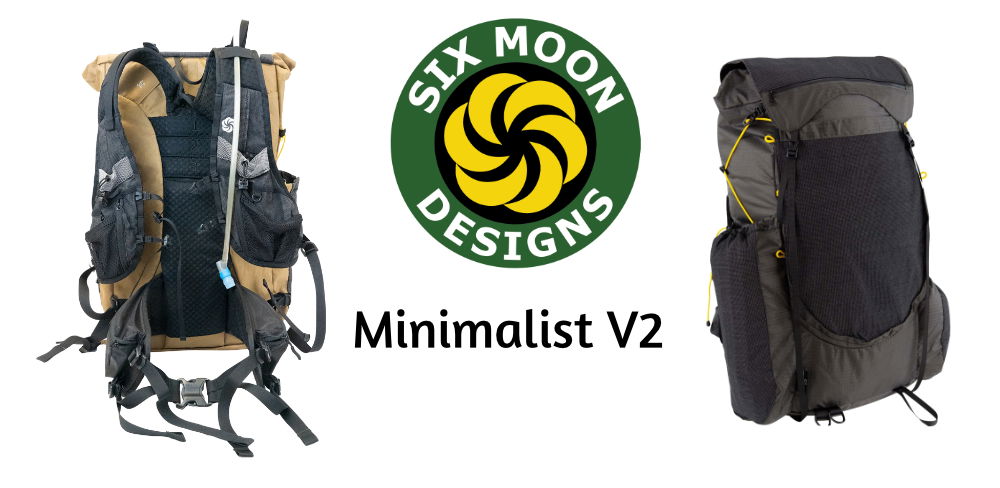
How about a backpack from a company whose founder was doing ultralight back in 1977? Today I’m doing a detailed review of the Minimalist V2 Ultralight Backpack from Six Moon Designs. And why not? Who else out there has nearly 50 years experience building ultralight gear? And does that even matter? Let’s find out.
Specs and Features
The total volume capacity is 59 liters – and that’s a combination of both interior and exterior compartments
- Total main interior volume is 49L
- Main compartment is 40L
- 9L extension collar
- 10L total between all 5 external pockets
- And there’s extra capacity via the hip belt pockets and the harness.
Weight is going to vary between roughly between 2.5 and 3 lbs. More precisely, that’s between 39.8-50.7oz or 1128-1437 g. The actual weight will depend on a few things:
- the type and size of harness
- Hipbelt size
- if you choose to go frameless,
- and what color/material is chosen
Max Comfortable Carry Load
With frame: 35 lb (15.88 kg)
Without frame: 25 lbs (11kg)
The frame is a Delrin Hoop Stay Frame that connects directly to the hip belt.
The material, Delrin, is a thermoplastic commonly used in automobile manufacturing. So, it’s tough, durable, and stable over a wide temperature range.
Primary Materials
If you choose the gray or the green it will be made from Robic Nylon.
If you choose any other color it will be made from EPX200 material.
The pack comes in 5 colors.
Both materials are very durable and very water resistant. In fact, the EPX200 is said to be “waterproof”. However, this doesn’t mean that the backpack is waterproof. It’s not waterproof because of the stitching, which is true for every stitched backpack.
The material that comes in contact with your back is a 3D mesh.
The flexible material of the pockets are made from Challenge Sailcloth Ultra Stretch.
Hip Belt. The hip belt:
- Is removable
- Has big pockets
- Has easy zippers on the pockets
- Has a big buckle that can be used with gloves on
- Has four tension adjusters
Harness Choices. There are three different harnesses to choose from:
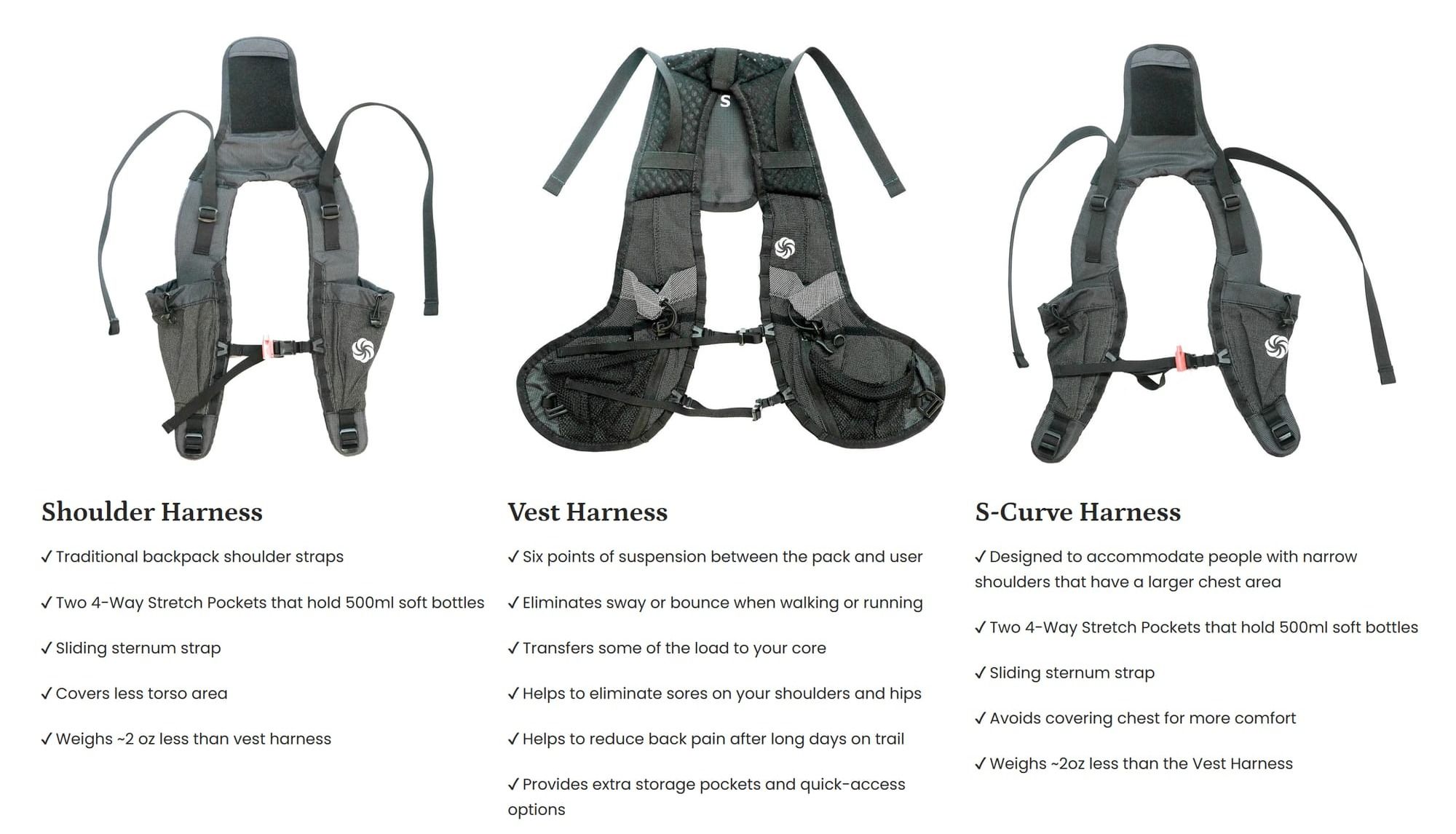
It’s super important to use their sizing chart when selecting your hipbelt and harness. Picking the wrong size harness or hip belt will change everything about how well this pack fits.
Other Features
- Adjustable Torso Length – getting the torso size right matters A LOT. This has 4 size adjustments. The lower the number, the larger the torso length. They also ship a tool with the pack to help change the size. This tool isn’t necessarily but it does make it a bit easier.
- Minimal Contact Back Panel – only the center part will have direct contact with your back, which is designed to help with air flow manage wetness from back sweat.
- Top Loading roll-top
- Internal Zippered Stash Pocket
- Attachment points for ice axe and trekking poles
- Compression tie out points along the front pocket in case you want to strap some shock chord on here
- Side compression straps to help secure tall items
- Dual hydration ports for those using a hydration bladder
- Removable hydration bladder bag
- Multiple adjustment points for sternum straps
My Testing Methodology
When I test backpacks, I first do a visual inspection. I look at the craftsmanship of the build. I look at the:
- Material for nicks or any obvious defects
- Stitching and reinforcements on stress points. I’ll look deep inside the pack to get a closer look. I’ll pull on the seams... just a little
- The bottom of backpacks can take a bit more wear so I’ll look at what did they do to make more resilient.
- Function of zippers, buckles, and anything with a mechanical function.
- Inspect any plastic parts for cracks or other defects.
I found nothing of any concern here.
Next, I Adjust the pack under load. It’s important that the pack adjustments are made under load because different weight will impact adjustments. I advise everyone to refer to the manufacturer recommendation because each pack is designed for a specific use and fit and they would know best about how to make the pack most comfortable. Six Moon Designs has a very helpful video on this. No matter how experienced you are, give this at least a quick look.
My next level of testing is to take it out on a few hikes. I took it out on a short hike with a full load... a couple miles on easy terrain. This allowed me the opportunity to dial in the adjustments and for me to get accustom to the pack features.
Then I took it out on a couple longer day hikes, again with a full load. But this time on more difficult terrain. I wanted to see how it felt on a typical trail – up and down hills, over rocky and uneven terrain. If I need to make adjustments, this is another great opportunity. Plus these shorter hikes gave me some experience with pack to figure out what micro adjustments might be needed, to determine how I want to use the external pockets, etc.
At this point it was ready for multi-day hike. I took it out on overnight hike in Colorado. The terrain was mixed. On this hike I actually went over the max carry weight. I loaded down with 37 lbs just to test the limits.
Results of Testing
Pros
Hip belt design
- I didn’t need to take off my gloves to buckle the hip belt. This matters most on cold mornings when I’m trying to keep my hands warm.
- Four independent tensioners really helps with stability. I can adjust this perfectly to allow the belt to hug my iliac bone – one strap was on top and the other on the bottom of that hip bone. This made for less slippage and better comfort. I’ve struggled with other belts, getting the perfect fit, usually having it ride on top of my iliac crest, constantly adjusting, and never finding the perfect fit. Not here.
Adjustable Torso
I was able to very quickly and easily adjust this, even on trail. It really makes a big difference when the torso length is just right. Many packs I’ve had come in two or three torso sizes – this one has 4 so you can really dial in the comfort level.
Vest Harness
I chose the Vest Harness because it gave me a few benefits I liked.
- It gave me the most adjustment flexibility
- It does a great job at load transfer and stability
- It feels great on my shoulders and back, even after many miles
- It also helps me maintain better posture. With this harness I find that I’m not leaning forward as much as I do with my other packs. This helped reduce back and should pain at the end of the day.
It’s VERY comfortable and it’s very stable. Like no other pack I have, this one feels like it’s part of me.
This harness also has some unique pocket options. These proved convenient for storing my Garmin so it doesn’t flop around, lip balm, phone, snacks, a small Ibuprofen container, my ID card. I normally don’t carry a water bottle up here, but I could. Maybe you could put a small tripod for your camera in here too.
Accessibility.
On some packs it’s sometimes a stretch to reach my water bottle in the side pocket. I did this easily on this pack. PLUS I was able to retrieve and return my camera tripod, which I can’t on any other pack I have.
Compression straps
Side compression straps are great for securing taller items in the side. But they don’t start at the top of the pocket, they start inside the pocket. What that does is, when I have fewer items in the pocket, it secures the bottom of my taller items, as well as the top to keep them more stable. The other compression tie out points are good to have as well. I can see me adding some shock cord here so I can hang my socks to dry.
Cons
Sternum strap and clips are really small. I can’t clip them with gloves on and it’s even difficult without gloves on.
There’s a lot of straps hanging off this thing. They don’t really get in the way of anything and they don’t really bother me. I think it’s just an aesthetics thing. I like things to be tidy. It might be good to have a way of taking up the slack. Maybe a Velcro strap or something.
The carry handle is thin. I like a more meaty, full-hand carry handle. With this thin handle, it feels like I need to treat it gently every time I move my pack. I’m afraid it’s going to rip over time.
I don’t think I like the brain on this. When the pack is full, the roll top can leave gaps. Gaps that may allow rain to get into the pack. So, I would expect if the pack has a brain on top, that it would cover the roll top no matter how full the pack is. This doesn’t. And so under wet conditions with a full pack, the brain doesn’t do much for me.
An easy fix might be to use a couple adjustable straps instead of it being sewn in.
I’m not a pack designer, but I’m sure there is a way to make this more functional.
Mixed – neither pro nor con.
I LOVE LOVE LOVE how comfortable this pack is. I attribute that to the vest harness, the adjustable torso, and the number of tension points, so I can dial it in just right for me.
BUT... It takes a couple tries to get to the place where it’s just right. Worth the time investment? I think so. It’s easy for me to justify spending an extra minute adjusting my pack when the payoff is many more hours of comfortable carry each day.
The front stash pocket. The material on here is a sailcloth stretch mesh type of material. It’s somewhat breathable but not nearly as much as more course net material on other packs.
The sailcloth won’t snag as easily, but if it does, a simple field repair using either tape or a few stitches will do it. And you’ll need to do that as soon as possible so it doesn’t continue to tear.
More course net material will snag easier but it’s not prone to tearing further so you many not need to repair it while out hiking. Plus with this net material you can easily see what is in this pocket so you an find things faster. And it has greater air flow allowing the contents to dry faster - or get wet faster. But with the sailcloth you might like that no one can see what you have in here.
I need to use this a while. It might all depend on what type of terrain I’m going through. Bushwhacking or trails with a lot of briers is probably a good test. It also might depend on the weather – how does this perform in really wet weather. Or how does it perform when I have more sun exposure? I don’t know. Time will tell.
Conclusion
I do a lot of nitpicking when I do reviews. I don’t mean to make a big deal out of minor things but I think it’s important to be more thorough.
Overall, I really like this pack. Comfort is the most important thing to me – everything else is secondary. And this pack is SUPER comfortable.
That’s what I have for you on this one. Hope it was helpful. If you have this pack, I’m very interested in your comments – especially if you’ve been using it for longer than I have.
Remember – go live like you want it! I’ll see you on the trail!