What Happens When You DON'T Bring Electrolytes on Hiking Trips?
Electrolytes have always been a fascinating topic for me. In part because of some medical issues I have that require me to pay attention to my electrolyte intake, but also because there’s an excess of electrolyte brand hype out there that I think confuses why and when we need to take them.
What are electrolytes and why do we need them?
Our bodies are a very complex hive of electrical activity. Right now, while you are reading and trying to understand this, there are millions of ions flowing and triggering cells in your brain. Every step we take, every movement in our bodies, every heartbeat and breath demands activity from cells charged with some electrical signal. And so it would make sense that our bodies be optimized for all this to work properly. And this is where the proper balance of electrolytes matter.
Electrolytes are minerals that carry an electric charge when dissolved in water. They help regulate fluid balance, muscle contractions, nerve signals, and pH levels in the body. So, it’s vitally important to get this right.
Electrolytes need to be balanced. By “balanced”, I mean that it can be either too high or too low. With electrolytes, the “more is better” approach doesn’t apply because too much can be just as dangerous as not enough.
I had just gotten off a series of hikes right before my last blood panel. My potassium was too high, which concerned the doctor because of my heart condition and digestive issues. I was likely eating too much of my dried fruit and nut mix. Since then I’ve cut a lot of that out of my diet on and off trail.
Imbalances can occur when we get dehydrated. And that’s easy to do when we are hiking in excess heat or any time we’re producing a lot of sweat. It can also happen when we’re sick and vomiting or when we have diarrhea or dysentery. Or, like in my case, it can be caused by a poorly balanced diet. Too much of a good thing can be bad for us.
With some conditions, there is a heighten the risk of electrolyte imbalances. A few examples are:
- malnutrition
- kidney disease
- endocrine disorders
- gastrointestinal conditions
- lung conditions
- heart problems
If a person already has any of these conditions, it’s even more important to correctly balance electrolytes. Mild electrolyte disturbances usually go unnoticed. However, more severe or prolonged imbalances, either too much or too little, can cause symptoms such as:
- fatigue
- muscle weakness or spasms
- nausea
- headache
- Irregular heartbeat
- High blood pressure
- confusion
And these symptoms, unattended and worsening, can lead to more serious issues, even death in the most extreme situations. So the message here is to not neglect proper electrolyte intake and balance.
Things often misunderstood
Here are a few things that are often misunderstood about electrolytes:
- Many believe that muscle cramps are due to magnesium or potassium deficiency. Although very low levels of magnesium or potassium can cause muscle cramps, the person who is having cramps or muscle contractions after prolonged and vigorous exercise is more likely suffering from low sodium levels that have been lost through sweating. When sweating, we loose about 5 times the amount of sodium compared to potassium and 50 times that of magnesium. Low sodium should be the first suspect when experiencing muscle cramps after a long day of sweating.
- Some believe that we need to take daily electrolyte supplements. If a person is not sweating much or doing vigorous exercising daily, it’s not very likely that person needs to take daily electrolyte supplements. That is, unless they are prescribed by a doctor for some condition. A balanced diet will normally give us all the electrolytes our body needs.
- Many people think of electrolytes as sodium, magnesium, and potassium. But there are other essential electrolytes we need for general health, such as calcium, phosphorus, bicarbonate, and chloride. These “other” electrolytes are not significantly depleted by sweating and therefore are not generally found in great quantity in electrolyte supplements. And these can be easily managed through a balanced diet.
What about electrolytes for hikers and backpackers?
Here’s a great question: Do we need to take electrolyte supplements, like drink mixes, every day while backpacking or hiking?
The answer is: not necessarily. It depends on our diet. And it also depends on our exertion level and duration. Medications we take may alter the equation. And the simple fact that there are differences between each of us in how our body manages hydration and electrolytes should change how we approach our electrolyte intake.
But generally speaking, let’s look at low, medium, and high exertion levels to better understand when we may need to consider supplementing our diet with electrolytes.
Low. On easier days with only mild exertion when there is very little sweating, we are likely getting enough electrolytes with the food we are eating. Think: salted nuts or nut butters, jerky, cheese, dried fruits, beans, tuna, etc. There are at least 50 natural food sources that contain the electrolytes we need. It would be good for backpackers to consider this list in meal planning.
The general rule is to avoid supplementing our diets unless we have an established deficiency that we cannot overcome with a proper diet. For instance, I need to take medication for a precancerous condition. I’ve tried everything to not take this medication; but it turns out that it’s really my only option. The down-side is that this medication blocks absorption of minerals, which has resulted in low bone density. I take supplements to help compensate for the mineral loss because it would take an enormous amount of food for me to get enough calcium and other required bone-health minerals. We should apply that same thinking with all required nutrients, including electrolytes. Make our food your plan A. And when that’s not enough, then consider supplementing.
Medium. On moderate days where there is some sweating but exertion is not prolonged, we might sweat out 2000 mg of sodium – and that number is going to be different for everyone. In this case maybe all we need is a little extra sodium and other electrolytes in your meals, maybe an extra couple handfuls of salted nuts or dried fruit. That is, providing we are otherwise maintaining a balanced diet.
High. On days were we have prolonged and vigorous exertion, we may be sweating out 18000mg of sodium. These are days when we most likely need to supplement our diet, maybe with an electrolyte drink mix. Nothing crazy. Not some complicated scientific formula. Just a simple replenishment of what is being lost through sweating – primarily sodium.
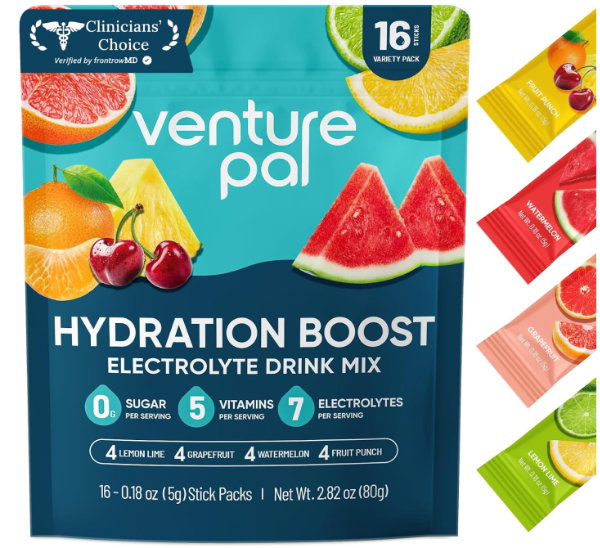
This is a great time to mention Venture Pal Electrolyte Drink Mix. It’s very simple – no gimmicks no hype. It has 1000mg of sodium, 200mg of potassium, and 60mg of magnesium per serving. The only sugar in these is from stevia leaf extract and, with the flavoring, it also provides 94mg of vitamin C. It’s a very basic formula.
This drink mix, maybe more than one on long, hot days, along with a balanced diet is all I need to maintain proper electrolyte levels.
When we read about electrolyte balances, as I suggested earlier, there are variables. There’s not a one-size-fits-all answer here. I can’t tell anyone to take a certain number of these mixes because I don’t know individual needs which may be impacted by medications and other factors. It will vary with activity levels, duration, and the amount of sweating. It will also depend on your dietary habits to include how much, how often, and when water is consumed.
Anyone wanting a good study on this should look up some of the medical research that has been done on this.
But, generally speaking for times when we sweat a lot, the sodium to potassium ratio in our electrolyte supplement combined with our diet is probably the most important factor to consider. Sodium intake should be 2 to 4 times that of our potassium intake. And a much lower intake of magnesium should be part of the formula to help with muscle function. x
Our food intake is usually enough to give us what we need for the other electrolytes (calcium, phosphorus, bicarbonate, and chloride), even under high exertion situations because most of the time, among electrolytes, it’s mostly sodium we loose when we sweat. However, be sure to check for electrolytes in your diet and/or daily multivitamin.
Monitoring and personalizing is important too. When taking electrolyte supplements, start small, monitor your body’s response for a couple hours. Do the symptoms go away or get better? If so, don’t take any more – because, again, too much isn’t good either.
And also consider that every day will be a little different, because our exertion levels change. Tailor your intake with the level of exertion – take less on lower exertion days, take more on higher exertion days.
The thing about electrolyte supplements that contain a lot of ingredients is that it makes this balancing act much more complicated. It stands to reason then that fewer ingredients would be better when trying to figure out how much supplementing is needed. That’s why a simple formula such as with Venture Pal makes adjusting the balance much easier.
What do Venture Pal electrolyte drink mixes taste like? One would think with a gram of sodium in each packet that these would taste salty. For me it wasn’t off-putting; it’s not overly salty. They have a nice balance of flavor too, actually very tasty.
I know there are a lot of electrolyte mixes on the market and we get a lot of marketing hype with all that. But, my advice is to just look at the ingredients and ignore the hype, because it’s actually quite simple: we are primarily looking to replace what we are sweating out. The rest should be in your diet.
One could also spend a lot of time and money trying to find the brand we like. I get it. The hunt can be discouraging. How about this: how about I give you a discount code that knocks 15% off every order you place through Venture Pal? Would that make it worth giving this a try? It contains only and exactly what you need; it’s tastes good; and cost less. You might as well try it – right?
Use code DAVIDDEAL or go to the Discounts and Deals page on my website: DavidonEarth.com – where you will find deals on a lot of hiking and backpacking gear.
Full disclosure: I do affiliate with this company – but like with all my affiliate companies – it’s not a big money-making thing – it’s quite small. And I only affiliate with companies I like and respect and, more importantly, that will do right by you. In the case of Venture Pal, it’s the no-nonsense, clean approach to their products and ingredients. They are based in the U.S. These are non-GMO, Gluten Free, Vegan, and Keto Friendly. It’s all good stuff and I really think you’ll like it.
Conclusion
Electrolytes are critically important for our bodies to function properly every day and especially during times of high performance demand. We don’t always need to take electrolyte supplements on our hiking trips – remember: proper diet first - but when we do need to take electrolyte supplements, we need to ensure a proper balance of essential minerals.
OK – so, while you’re out there living like you want it – take good care to make sure you are getting the right level and balance of electrolytes.